Tīna Graudiņa and Anastasija Samoilova have certainly written their names into beach volleyball history. Last year they became the first Latvian women to win both the European and World Champion titles, and as two-time participants in the Olympic Games, they’re redefining Latvia’s role on the global beach volleyball scene. But behind those astonishing results stands a lot of heavy training, a bit of luck, and a good dose of the tenaciousness so characteristic of Latvians.
With the new season just starting, we had a chat with these top beach volleyball players about their careers, aspirations, and how a pair from a cold Baltic country managed to reach new horizons in a summer sport.
It’s early March and you’re in Tenerife, actively preparing for the Beach Pro Tour. How are you feeling there?
Anastasija: We feel great! When we’re in a training camp, we can focus solely on training and our performance on the court.
Tīna: In Latvia, training is still our priority, of course, but there are plenty of other things to do, too. In a training camp, our focus is only on volleyball.
You’ll be one of the favourites in this tournament. Does that make it easier or more difficult to play?
A: Actually, we don’t think about it that much. We’ve been back on the court only since February, when the season started, so our main goal is to get back up to game pace and regain our physical shape. We were on vacation before this tournament, which means that we only did strength training and no actual volleyball practice. Thus, we’re now mostly focusing on our performance on court, how we feel, and, even though we’re satisfied with our game, we’re trying to rebuild our shape step by step. The most important matches are coming in July and August.
T: Our goal is not to win every single tournament in which we participate, although it’d be great if that happened, of course. This season we have a clear target – the European Championship – and therefore we’re going to take things a little easier at other tournaments so we can do our best at the European Championship.
A: This is the first tournament of the year, and all the teams have only just started preparing for the season.
What’s your usual routine and training plan before tournaments?
A: When we’re in Latvia, we have two training sessions a day. In addition, we have meetings with our coach to analyse our games from the previous season. Technically, it’s the same process as in the training camps. But in the camps, the routine is more predictable. We know we have either two volleyball trainings or a strength training and a volleyball session.
T: In regard to tournaments, we usually arrive at the location at least three days before our first game. If the tournament takes place in a completely different time zone across oceans, we arrive even earlier to adjust to the new rhythm. In those three to four days before the tournament we get a feel of the particular place and experience its air and sand so that we’re familiar with it before the match.
No sightseeing, only hard work on the court?
T: Yes. Eat, sleep, play volleyball. Nothing outside this holy trinity of volleyball.
A: Yes, we don’t go outside to see the city or seek any adventures. Our priority is the competition and the training to prepare for it.
T: There’s an inside joke amongst volleyball players that as soon as you lose in a tournament, you win the right to become a tourist. That’s when you can finally walk around and take a look at all the beautiful places. But the better you play, the longer your tournament is. If you reach the final, you don’t manage to explore anything at the destination.
But because you mostly play in warm climates, the weather would probably be perfect for sightseeing.
A: When we played last summer, there was often rain and strong winds. It was cold even in Brazil! Oftentimes people think that it’s warm outside and the sun is always shining in the world of beach volleyball, but that’s surely not the case. We also need to play when it rains and when it’s very hot.
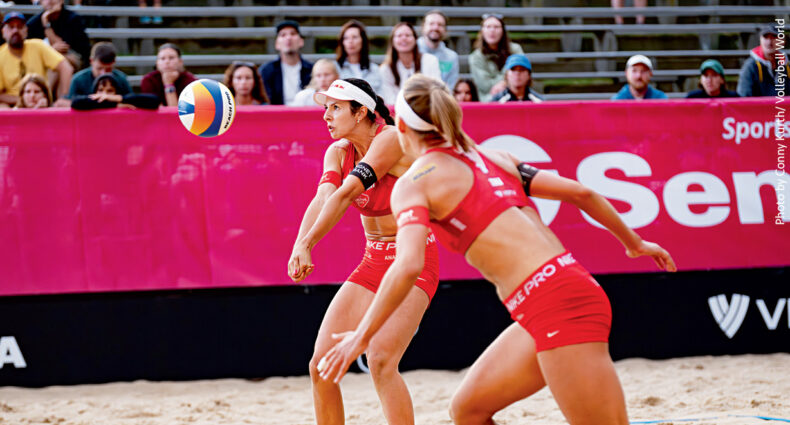
In a Beach Pro Tour Elite tournament, Hamburg, 2025
What are your favourite weather conditions for a game?
T: I like it when it’s sunny or a little bit cloudy. The most important aspect is that it doesn’t rain and the temperature is around 18 or 19 degrees Celsius. Anastasija probably likes it slightly warmer.
A: Yes, I’d definitely prefer it a bit warmer. But we know that in comparison to other teams, we Latvians have the advantage of being more resistant to the cold. The Americans and Brazilians play their best when it’s 30 degrees Celsius, but when it’s 13 degrees, we’re in a better position. We’re more used to the cold and can adapt better.
It’s true – every time you win against teams from warmer and sunnier countries, people wonder how a team from cold Latvia can achieve such high results.
T: First, I think Latvians are very talented in sports and culture. We also have the tenacity and pride to show all the big countries that we’re skilled and we can compete right up there with them. All the foreign coaches who’ve worked with us also confirm that they’ve felt this very special Latvian grit and urge to win that sets us apart from other nations.
A: It also undeniably involves a lot of work. I always say that everything is in our hands, but I’m also very grateful for everything we’ve experienced. These paths have made us strong, tenacious, and ambitious. We’ve learned something from every coach who has trained us. At the beginning we were trained by Latvian coaches, and that shows that our local coaches are amazing and have a lot to give. We were always among the best – we’ve trained, we’ve worked, and we’ve done everything in our power to get to where we are now.
Last year in Adelaide, Australia, you won the highest title in your careers when you became World Champions. What do you think happened – was it because of your hard work, a bit of luck, or just the right time had come?
T: I think it was a combination of all of these factors. This was our fourth championship, and we had reached ninth place in all the previous ones. That was still a great result, but we wanted to achieve more. Last year, we had reached such a level of maturity as a team and also on the global volleyball scene that nobody considered us a new team anymore. We had become a seasoned, established team. We also had an excellent coach and a great support team that prepared us both physically and mentally. So Anastasija and I just had to go out on the court and do our job, which, of course, was not easy. But now, looking back, I can say that it just flowed naturally without extensive effort.
A: We had a tremendous wish to achieve better results than in all of our previous world championships. By getting past the round of 16, where we usually lost, we had already reached our small goal. So then we had to continue our great game. We also felt incredible support from the Latvians in Australia; it felt almost like playing at home. All these factors helped us win.
What was the most memorable game?
T: Hard to say. I remember bits and pieces from all the games. Of course, the final was emotional, but I think the most memorable for me was the semi-final. I was truly surprised at how easily the game came for us. I expected the Brazilians to step up in their game, but we suppressed them with ours so much that, metaphorically speaking, they didn’t even show up on the other side of the net.
A: For me, it was the quarter-final game against the Americans. We had played against them twice in that season and lost both times. But in the quarter-final, we just did our best and the result arrived fairly easily. The game didn’t seem as hard as both previous times during the season.
Some of your most unforgettable matches have probably taken place at the Olympic Games, where you participated twice: in Tokyo in 2021 and in Paris in 2024.
A: Both experiences were so different! In Tokyo, the Covid-19 pandemic was in full swing and we were under lockdown in the Olympic Village; we could only leave for training and games. The stands were empty and we had to spend most of our time in our room. Paris, on the other hand, was a real celebration of sports. The stands were full of people, and we really felt the support. I can’t describe it in any other words than that it was a real celebration.
You won fourth and fifth place, respectively. Those are astonishing results, missing a medal by just an arm’s length. What did you think of your results? Did you expect a medal?
T: We were really satisfied with our fifth place, because volleyball progresses every year, and you really have to maintain your level over the years. We lost only to the Olympic champions, and it was a good game. So I definitely left Paris happier and more satisfied than Tokyo.
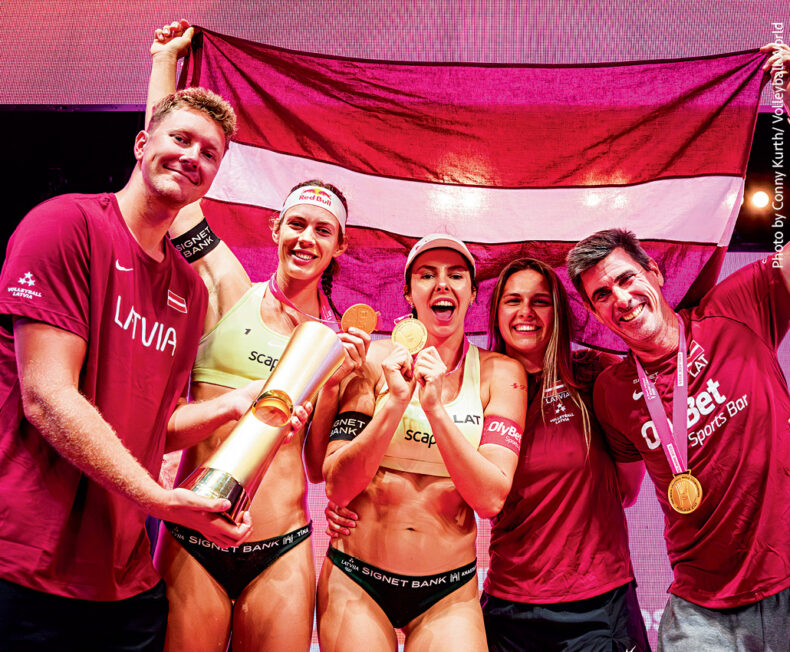
In a Beach Pro Tour Elite tournament, Hamburg, 2025
What’s mentally easier for you: losing at the beginning of a tournament, or barely missing out on a medal?
A: Definitely missing out on a medal, because we want to play until the very end. Losing at the beginning would be sad, because we know we’ve been one of the top teams over the past years, and not getting past the group stage would be very painful. We’ve put in a lot of work, and therefore the goal is always to reach the highest results. Fourth and fifth place are great standings in the Olympic Games.
During the Paris games, your huddle in the 30-second timeout went viral on national media. You were saying to each other: ‘You’re the best!’, ‘No, you’re the best!’ Is that how you motivate each other during a game?
T: We’ve known each other for many years, and we’ve established our manner of communication on the court. During a game, you need to be precise, blunt, and specific. There’s not enough time to lean into politeness and formality. We’ve learned to trust each other that we both want to win, and that we’re both trying our best to do that. Therefore, everything we say must be understood as an attempt to improve our game. Since we both really want to win, well, there’s really no need for any additional motivation to try even harder.
A: Regarding that viral moment, it just showed how our game conversations flow. Sometimes they even turn into kind of a joke. I remember once trying to motivate Tīna by saying, ‘Tīna, you have big lungs! You can run even more!’
Do you remember the first time you met and how you started playing together?
A: We knew each other before, but I vividly remember both of us taking part in a beach volleyball camp at Brazilija, an indoor beach volleyball hall in Riga. In fact, it was not far from the airport. My coach brought Tīna and me together, introduced us, and said that from now on we were going to play as a team. That was an impactful moment for me, because I had just been enjoying the game and playing for fun. But then I was put on a team with Tīna, who I knew was one of the best players in our age group. That was back in 2013.
I’ve read in other interviews that you’ve described your relationship more like being colleagues than friends. You don’t need to necessarily spend a lot of time together off the court.
T: (Laughs.) It’d be crazy if we spent even more time together. People do not understand how much time we already spend together – I’d say it’s around 90% of our lives. And therefore we need that remaining 10% to ourselves so that Anastasija can spend time with her husband and I can be with my own friends and family. It’s such a short period of time that we can spend apart, and we enjoy being around other people as well.
A: If we compared all of the hours in the year that I spend with Tīna and the time I spend with my husband, the results would definitely be in Tīna’s favour (laughs). But my husband isn’t jealous; he understands that this is my job. Moreover, it’s a job I truly like.
How did you get acquainted with volleyball in the first place?
T: For me, it began with my dad, who was a volleyball player. Thus, during the summers, we often played volleyball and other ball games in our family garden.
A: I was introduced to volleyball by a coach who came to our school and encouraged everyone to take part. Before that, I didn’t like sports at all.
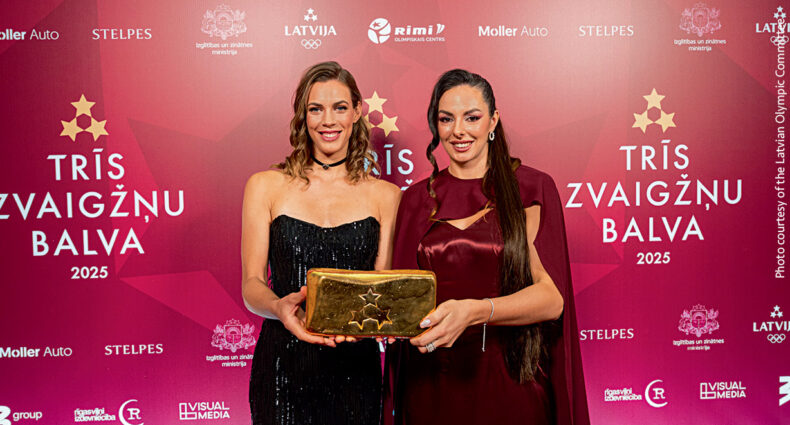
After receiving the Three Star Award for best small sports team of the year, Riga, January 2026
At which point did the hobby turn into a serious career opportunity?
A: For me, the turning point was the U-22 European Championship in 2016. We won the championship and were accepted into the Latvian Olympic Elite Programme, which provides funding to cover training and competition costs. That’s when I realised that I could just study and play volleyball, that I didn’t need to look for a job to cover my expenses. I realised that I had proven my potential in beach volleyball, because now I got state financing to train, compete, and do my best.
T: Becoming part of the Latvian Olympic Elite Programme gave us financial support and the hope that we could actually earn money with this, but I still had doubts. I was considering focusing more on my studies, looking for a job, climbing the career ladder… However, during my first year at university, I decided that I truly want to pursue a professional sports career. I knew I had ambition; I wanted to win and be the best, and I wanted to see how far it would take me.
When you began playing, did you have any particular goals you wanted to achieve?
T: Honestly, no. I just really enjoyed the game and always had the urge to win. I knew that, whatever may come my way, I wanted to win. The leagues and the competition levels changed, but my desire to win remained.
A: I remember taking part in the 2012 School Indoor Volleyball Championship with my school. Our team lost fairly quickly, but I had the opportunity to watch the final. At that moment, as a young girl from Daugavpils, I thought it would be so cool to call my mother one day and say, ‘Mom, I’m the world champion!’ But it seemed impossible back then. I wasn’t playing beach volleyball professionally, and it’s almost unrealistic to achieve such results in indoor volleyball. But the thought probably remained somewhere in the back of my mind.
When I began playing more seriously, I also had the ambition to win the European Championship, which we did twice, and then to win the World Championship as well.
Tell us more about your training.
A: We have a session in the morning, then another one in the afternoon. During the day, especially if we’re in Latvia, we have lots of meetings and sponsorship jobs, we visit schools to talk to students. We also have physiotherapy and psychology sessions. Plus, we have to find time for recovery and relaxation, because we cannot only train. Our job is physically very demanding, and therefore we need to give our bodies a rest to be prepared for the next day.
T: I tell people that we train four hours per day, and they always assume that the rest of the day is free, but that’s not the case. Recovery is an important part of our routine.
That means we cannot go on hiking trips on weekends, because during the season, our work takes up 24 hours a day, seven days a week, and we need to control what we do, what we eat, and how we recover. We only get true relaxation between seasons, in December and January. That’s when we can deviate from our sleep schedule, attend parties, eat more desserts. For the rest of the year, we’re totally focused and disciplined, even outside the training sessions.
A: We’re under a lot of stress during the season. Even during the recovery periods, we’re preparing for the next training session or game. And even when we’re not on the court, we’re still mentally there.
Your job is so physically demanding and you burn a lot of calories, so what’s your diet like?
T: We avoid any sugary drinks and drink mostly water. We especially focus on our diet during the tournaments. Even if our appetite isn’t that strong, we push ourselves to eat carbs, chicken, and pasta in order to have energy the next day.
A: I’d say we eat healthy, but that means different things for different people. We don’t eat very fatty meat, but other than that, our meals are very simple. Pasta, rice, chicken – which we’re already tired of – vegetables, fruits, berries, dairy, and bread.
T: It’s important to note that we don’t count calories. Our physical form is crucial, but our results don’t depend that much on our physical shape as it does in swimming or athletics. For us, strategy and mental stability matter more.
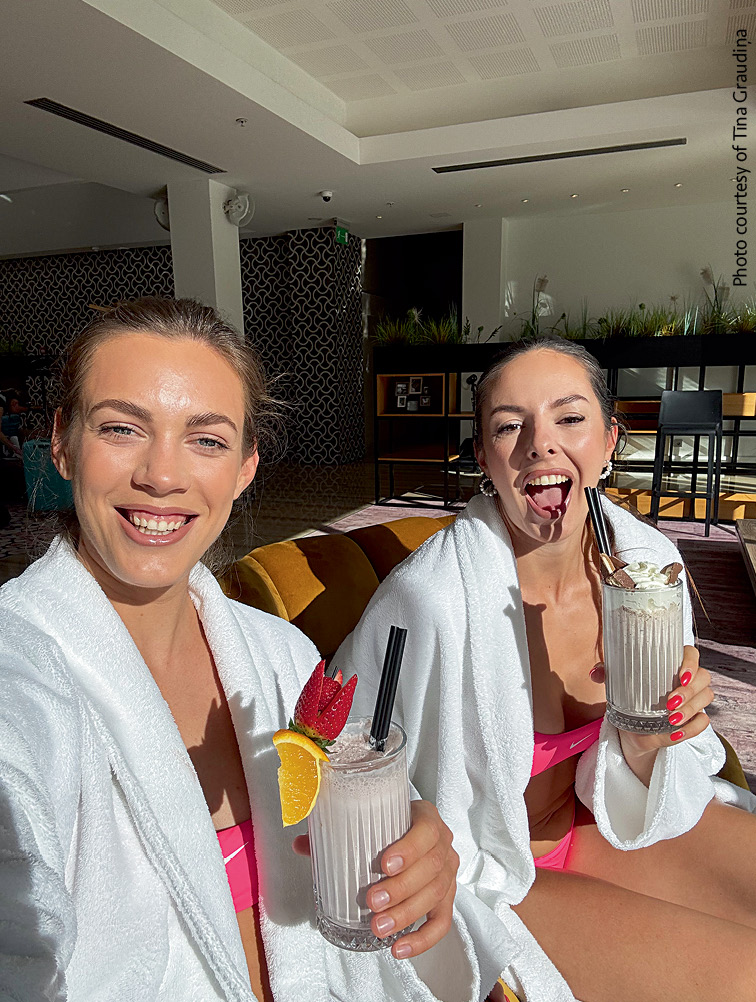
Recharging
What do you prefer to do on your days off?
A: I like to spend time with my friends and family and do something that doesn’t require a lot of my energy. I like to go on walks, but nothing too physically demanding.
T: We also try out other sports, and we meet friends we’ve sometimes had to turn down during the season due to our training schedule. I personally truly enjoy being able to not step on an airplane and stay in one place for a longer period of time.
Speaking of flying, have you counted how many flights you take a year?
T: Around 60 to 70, with various airlines around the globe.
What do you do during flights? How do you relax?
A: airBaltic provides super-fast internet on its aircraft, so that’s definitely something we enjoy. We can finish reports and documents for work, or we can just relax and scroll through social media. But on long-haul flights, we try to sleep as much as possible so that we’re full of energy when we reach the destination.
What are some of the personal qualities you’ve gained from playing volleyball?
A: There are a lot of them. But sports in general teaches you to adapt, because there are many different situations you encounter throughout a game. There are so many different factors that inflence it!
T: We also learn discipline and how to communicate well. I think this sport has made me more resistant towards criticism. I must quickly understand that I’ve made a mistake, and I need to get over it as quickly as possible instead of ruminating about what went wrong and why.
I’ve also learned to trust the process. For example, if I train today and I don’t perform super well, I cannot be angry at myself and question how am I ever going to become a European champion with such a performance. No, I need to trust the process and believe that I will get better by simply doing the same things every day. If I do that and I become at least half a percent better every day, I’ll be ready by the time of the competition. This is something that can be applied to any discipline in life.
With your careers and results taking off, you’re definitely gaining more recognition.
A: In Latvia, we definitely do feel recognised, especially after the World Championship. People approach us in the streets to share their stories about how they watched our game, cheered for us, and celebrated. They share their emotions and we’re happy to listen.
T: I always think that if a person in Latvia actually approaches you to say something, that already means a lot. We’re shy by nature and hardly approach anyone. This means that if one person has approached us, probably ten more also recognised us but did not approach us.
But people in Latvia are extremely friendly, they’re very positive supporters, and we love to meet them and chat about anything! I guess that if we’d come from another country, maybe we wouldn’t be that recognised. Being from Latvia is a great plus. And the recognition doesn’t affect our daily lives.
Do you feel like beach volleyball has become more prominent in Latvia after your success?
A: I’d say so, yes. After the Olympic Games in Tokyo, I received a message from a person who owns a beach volleyball court, and he wanted to say thank you, because the court would now experience a big inflow of girls wanting to play beach volleyball. I understand that a similar situation occurred after our World Championship win. I personally like to receive messages on Instagram in which girls write that they’ve begun playing volleyball because we inspired them on TV. That’s the best way we can give back.
What would you say to girls who have just started their journey and want to eventually match your success?
T: I wish for them to find the one thing they really like. Because it’s not worth trying to get through closed doors and do something through tears and dissatisfaction. Everyone needs to find their own passion in sport; beach volleyball is not the only option. The most important thing is that the sport makes you happy.
A: I agree, you must enjoy the sport. Of course, there will be days when it gets hard, but overall, it should provide joy and happiness. Not everyone will become world champions, but sport is the basis of a healthy and active lifestyle, and it just does the best for us.
How would you like the beach volleyball world to remember you and your legacy?
A: We’ll be remembered as world champions. The second and third place finishes are forgotten, but the winner remains in the books. But I hope people will still think about us when we’re no longer active athletes and are helping to develop our sport.
T: We would also like to be remembered as a creative team that never gave up. A dangerous team that could always find ways to win.
Words by
Marta Metuzale